
Distinctive
Hand-tuned typography, careful colour palette, original layouts on every page. Reads as “made for this universe”, not “made from a template”.
Case study · Content-heavy site
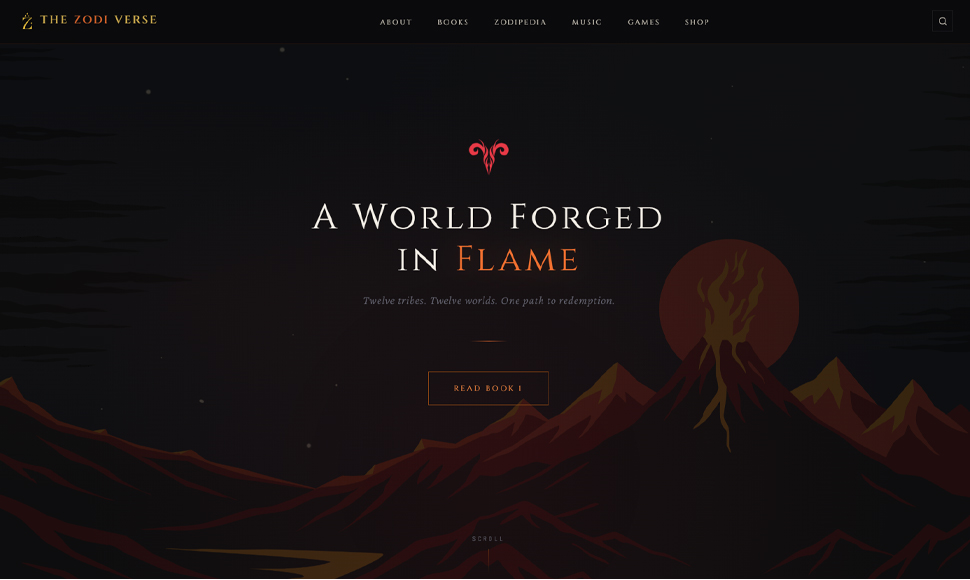
A transmedia fantasy universe — books, music, encyclopedia, characters, shop — rendered as a single cohesive site. Looks custom, feels professional, costs nothing to host.
The problem
Zodiverse is a multi-format fantasy universe: a series of novels, music releases, an in-world encyclopedia, character lore, and direct book sales. The author wanted a site that genuinely felt like a finished, distinct creative world — not a Squarespace template with a custom logo dropped on top. Thirty-ish pages of richly-formatted content, with a navigation system that would stay consistent as new books, characters and entries were added. WordPress was rejected (too much plugin maintenance, too slow). Stock site builders were rejected (too generic). The answer had to combine a hand-crafted look with low ongoing effort.
The approach
A custom-designed static site, but with one important trick — the navigation menu and footer live in a single source file. Every page on the site pulls those from one place. Add a new book? Update the menu file once; every page on the site shows it. Same for the footer, the social links, the call-to-action banner. This gives the simplicity of static pages with most of the maintenance benefits of a content-management system, at zero ongoing cost.
Built right
The site should look like an extension of the author's creative work — typography-led, properly composed, atmospheric — and behave like a serious modern site: instant loads on any device.
Hand-tuned typography, careful colour palette, original layouts on every page. Reads as “made for this universe”, not “made from a template”.
Pages render instantly on any phone, anywhere. No build step, no plugin loaders, no animated splash screens — just clean pages.
Runs on the cheapest hosting tier money can buy. No database to manage, no monthly content-management subscription. Bills don't grow with the audience.
Adding a new book, encyclopedia entry, or character profile is a matter of copying an existing page and changing the content. The navigation updates from one shared file.
What's on the site
One detailed page per book with cover, premise, sample chapter, buy-now button. New books slot in cleanly.
An in-world reference covering the universe's heroes, factions, places and history. Searchable; cross-linked between entries.
A separate section for the universe's musical companion releases. Track previews, release notes, links to streaming platforms.
Books sold straight from the site through an integrated checkout. No platform middleman taking a cut on every copy.
Plugged into the author's existing mailing list. New release announcements go to a list the author actually owns, not a social platform's algorithm.
Original illustrations, cover art and atmospheric photography throughout. No stock images anywhere.
Outcome
The site is what readers see first when they hear about the books — and it does the job: it signals that this is a real, ongoing universe with serious craft behind it. The author can add new entries without calling a developer. Hosting costs are negligible. The site has been live and trouble-free since launch, with the kind of maintenance burden you'd expect from a small website rather than from a publishing platform.
What I'd do differently
The first version of Zodiverse didn't include a search box for the encyclopedia — readers had to navigate to entries through menus. Search was added later and immediately became one of the most-used features. Lesson banked for any content site: if your audience is exploring rather than reading linearly, give them search on day one.
Want a content site like this?
Most multi-page sites don't need a content management system. They need careful design, shared navigation, and a sensible structure for future updates. Quoted fixed-price after a free 15-minute discovery call.
More case studies