
No download required
Players never visit an app store. Riverhold runs inside the Telegram app they already have, with one tap. New features ship the same day they're built — no review queue.
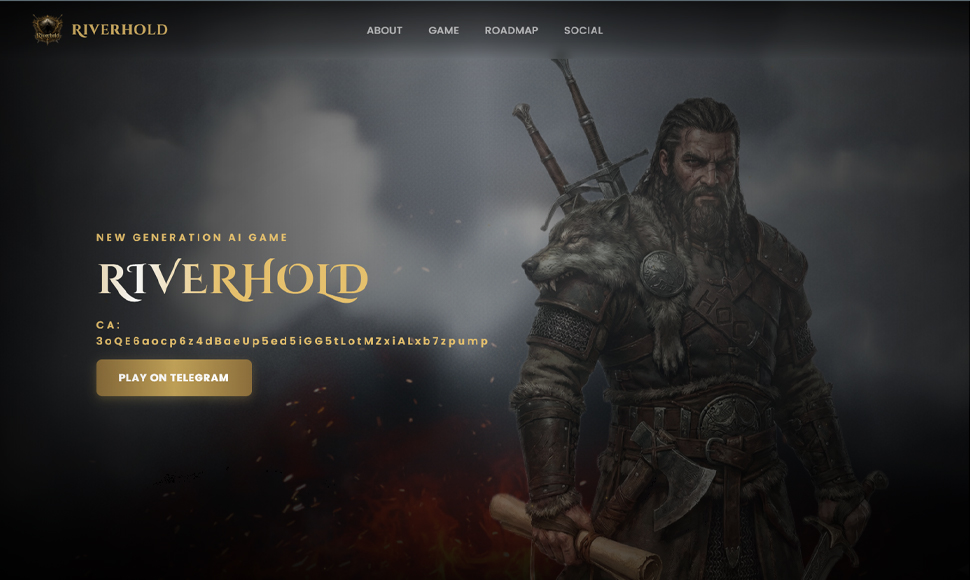
Case study · 18-month build, still live
A multi-month, ongoing project. Full role-playing game playable directly in Telegram on any phone — no app store install, no separate website to remember. Active community of players around the world, with its own digital currency that trades publicly. Built end-to-end by one person.
The problem
A community game that exists where the community already is — Telegram. No native iOS or Android app to publish, no 30% app-store cut, no 6-week review cycles every time a feature ships, no second login for players to remember. At the same time the game needed real depth — combat, character progression, social systems, a working economy with its own currency — not a tap-to-earn novelty. The challenge was building something people would still be playing a year later, on a platform most developers treat as a side channel.
The approach
Rather than disappearing for a year to build a “launch version”, the game was opened to a small group of players within the first month and has been improving every week since. Players see what's coming, suggest balance changes, report bugs in a shared chat, and shape the direction of the next release. This kept the project honest — every feature has been tested by real humans long before it ever became permanent.
Built right
Every design and engineering call optimised for one thing: a player can hear about Riverhold, tap a link, and be playing within five seconds — on any phone, anywhere in the world, no install, no account creation, no friction.
Players never visit an app store. Riverhold runs inside the Telegram app they already have, with one tap. New features ship the same day they're built — no review queue.
Every player is also a Telegram contact who can be reached directly. Announcements, events and content updates land in their messages, not lost in an algorithmic feed.
The game's currency exists outside the game too. Players can withdraw it, trade it, hold it — earning in-game value translates to real value, and the token has its own public market.
Run-time costs are tiny — the entire game serves its players from a single server. Tens of thousands of more players could join before the infrastructure would need to grow. No surprise hosting bills.
What's in the game
Turn-based combat, story quests, hunting, mining, treasure hunting — every classic RPG activity rendered in a Telegram-native UI with painterly artwork on every screen.
Players form guilds, build shared buildings, manage finances together, and run multi-player raids against bosses. Real coordination, real shared rewards.
Hire and customise a warband of NPC mercenaries with distinct classes, equip them, send them on solo missions while you sleep. They earn their own income.
Player-to-player auction house, mint exchange that prices in-game items against real on-chain currencies, daily price feeds. Whole economy lives inside the game.
Players can stake the in-game currency for yield. Long-term holders earn a share of the game's revenue stream — turning passive players into invested stakeholders.
Every screen designed in a consistent “occult dark fantasy” visual style. Hundreds of unique item, character, location and creature illustrations. No generic stock art anywhere.
Outcome
Riverhold has an active player community spanning multiple continents, with players logging in daily for weeks and months. The in-game currency is listed on a public market and is genuinely traded. Updates ship every few days — the game has never been “done”, by design. The whole operation runs on a single small server with monthly hosting costs in single digits.
What I'd do differently
For most of its first year, Riverhold had no proper tutorial — new players were dropped into a complex game with hundreds of menus and had to figure it out themselves. Lots of curious people tried it once, got overwhelmed, and bounced. A guided onboarding was eventually built (and conversion improved sharply) but it should have existed from the first public release. Lesson for any community product: the first 60 seconds matter more than the next 60 hours of features.
Want something like Riverhold?
Most communities, brands and product teams underestimate how much can be built directly inside Telegram. Mini-apps, full WebApps, community moderation, customer-service bots, token economies. Quoted fixed-price after a free 15-minute discovery call.
More case studies